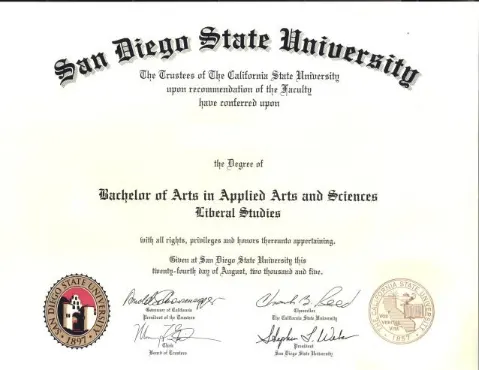
If you're an international student at San Diego State University, there's a good chance you'll need U.S. documents recognized in your home country, such as your diploma for a job or graduate program, your transcripts for credential evaluation, or a power of attorney so family can act for you while you're away.
For most countries, that means getting the document notarized and then apostilled. Here's how it works for SDSU students.
Step 1: Find out exactly what your country requires
Before you start, check with the school, employer or government office that will receive your documents:
- Do they need an apostille or an authentication? Countries in the Hague Apostille Convention accept an apostille. Other countries need an authentication and usually embassy legalization. See Apostille vs. Authentication.
- Do they want the original diploma, a transcript, or both?
- Do they need a certified translation?
Getting this right first saves time and money.
Step 2: Get your diploma or transcript notarized through the SDSU Registrar
The California Secretary of State can only apostille a document with an official signature it can verify, such as a notary's. For university documents, that means a notarization involving the Registrar's Office.
Here's what to know about how SDSU handles it, according to the SDSU Office of the Registrar:
- SDSU doesn't have an in-house notary or apostille service. You arrange a mobile notary to meet you at the Office of the Registrar, and the Registrar's Office coordinates notarizing your university-issued documents.
- Contact the Registrar before you order a transcript for notarization. Transcripts already in your possession or delivered through Parchment (paper or PDF) can't be notarized for this purpose.
- Plan around the semester. Notary assistance is suspended during the first two weeks and the last two weeks of each semester, so check the Academic Calendar and plan ahead.
We work with SDSU students regularly and meet you at the Registrar's Office. See our SDSU mobile notary page.
Step 3: Get the apostille
After notarization, the document goes to the California Secretary of State:
- Fee: $20 per apostille, plus a $6 handling fee per official's signature for in-person requests
- How: by mail, or in person
If you're leaving the U.S. soon, start early. Mail processing times vary, and you'll want the finished documents in hand before you leave. We can help you submit for the apostille. See our San Diego apostille service.
Other documents international students often need notarized
- Power of attorney. This lets a parent or relative handle banking, property or university matters for you, at home or in the U.S. If it will be used abroad, it usually needs an apostille too.
- Sponsor or financial support letters, which some programs and agencies ask to be notarized
- Translator's affidavits. A translator swears to the accuracy of a translation.
- Consent and authorization letters for a family member to collect documents on your behalf
- Affidavits for visa, scholarship or government applications
Can a notary certify a copy of my passport or diploma?
Usually no. In California, a notary can only certify copies of a power of attorney (and entries in their own journal). A California notary can't certify that a copy of your passport, diploma or transcript is a true copy.
Some agencies accept a "copy certification by document custodian" instead: you sign a statement that the copy is true and complete, and the notary notarizes your signature. Ask the receiving agency whether they accept this before your appointment.
What ID can international students use?
A passport from your home country is acceptable ID for a California notarization, as long as it's current or was issued within the last five years. A U.S. driver's license or California ID also works. See What ID Do I Need for a Notary in California?
Your SDSU student ID can't be used to identify you for a notarization.
Quick checklist for SDSU students
- ✅ Confirm whether your country needs an apostille or an authentication
- ✅ Contact the SDSU Registrar before ordering transcripts for notarization
- ✅ Avoid the first and last two weeks of the semester
- ✅ Bring your passport or another valid ID
- ✅ Book a mobile notary to meet you at the Registrar's Office
- ✅ Leave enough time for the apostille before you travel
We also help UCSD and USD students
Studying at UC San Diego or the University of San Diego? We provide the same diploma and transcript notarization and apostille help for UCSD and USD students. Contact your Registrar's Office, then book with us.
This article is general information, not legal advice. University and government procedures can change, so confirm current steps with the SDSU Office of the Registrar and the agency receiving your documents.