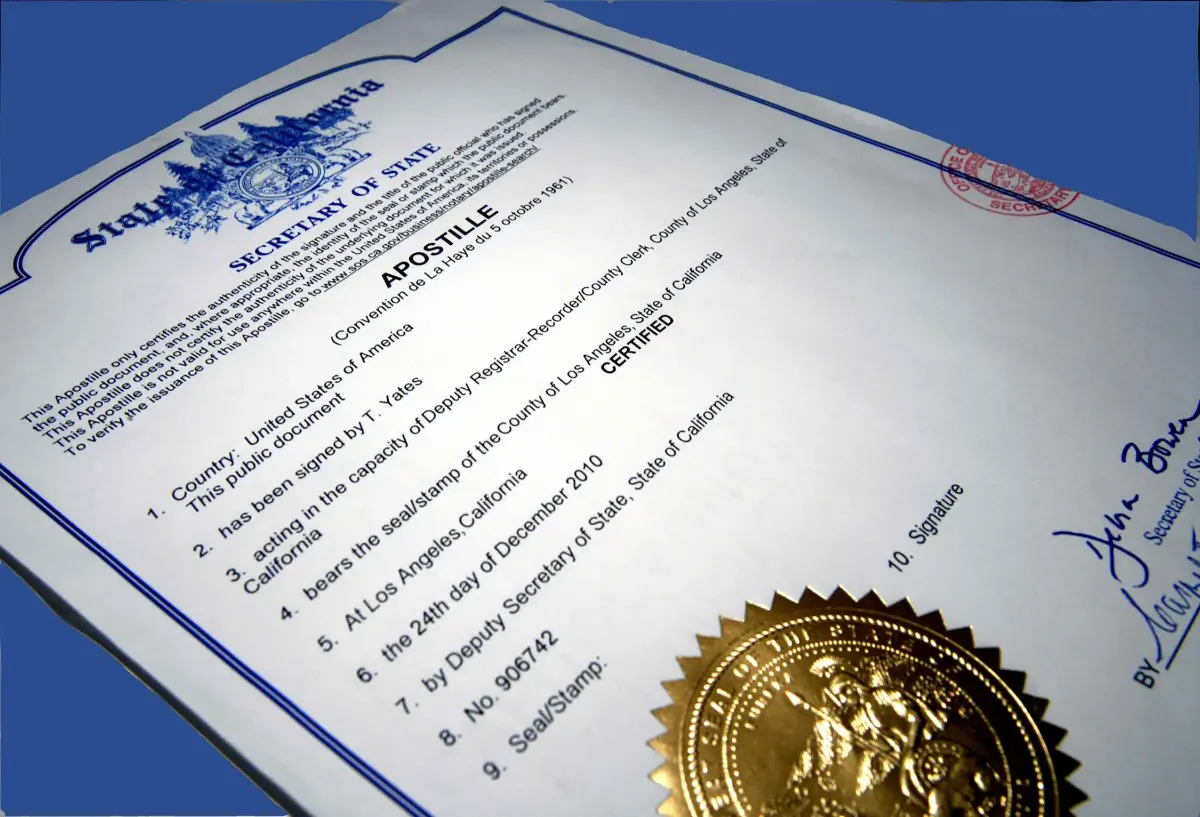
If you're sending a U.S. document overseas, such as a power of attorney, a diploma, a birth certificate or a business document, the receiving country will often require proof that the document is genuine. That proof is either an apostille or an authentication.
Which one you need depends on two things: where the document is going and who issued or signed it.
The short answer
- The country is a member of the Hague Apostille Convention: you need an apostille.
- The country is not a member: you need an authentication, and usually embassy or consulate legalization after that.
You can check whether a country is a member on the Hague Conference's official list. More than 120 countries belong, including Mexico, Canada, China, Japan, South Korea, India, the Philippines, the United Kingdom and most of Europe and Latin America. Canada and China both joined recently, in 2024 and 2023, so older instructions you find online may be out of date.
What is an apostille?
An apostille is a certificate attached to your document that confirms the signature, seal and authority of the official who signed it, such as a notary public or a county clerk. It does not verify what the document says.
Once a document has an apostille, it's accepted in any other member country with no further steps. For a full overview, see What Is an Apostille?
What is an authentication?
For countries that aren't in the Hague Convention, the process has more steps. It typically includes:
- State-level certification of the document
- An authentication certificate from the U.S. Department of State
- Legalization by the destination country's embassy or consulate in the U.S.
Requirements vary a lot from country to country, so contact the embassy or consulate first to confirm exactly what they need.
State documents vs. federal documents
Who issues the apostille depends on who signed the document:
| Document type | Examples | Who issues the apostille |
|---|---|---|
| California documents | Notarized documents, California birth, death and marriage records, California court documents | California Secretary of State |
| Federal documents | FBI background checks, documents signed by federal officials | U.S. Department of State |
A document notarized by a California notary is a California document, so it goes to the California Secretary of State.
How to get a California apostille
- Get the document ready.
- If it needs a notarization, have it notarized by a California notary. The notary certificate must be in English, but the rest of the document can be in another language.
- If it's a vital record, use a certified copy from the county recorder or the California Department of Public Health.
- Submit it to the California Secretary of State, by mail or in person.
- Pay the fee. The state charges $20 per apostille, plus a $6 handling fee per official's signature for in-person requests.
- Receive the document with the apostille attached, then send it to the destination country.
Common mistakes that cause rejections
- Using a photocopy. Vital records must be certified copies, not photocopies.
- An incomplete or incorrect notary certificate. If the notarization has errors, the apostille will be refused and you'll have to start over.
- Sending a federal document to the state, or a state document to the federal office
- Assuming every country accepts apostilles. Non-Hague countries need the authentication process.
- Not checking translation requirements. Many countries require a certified translation in addition to the apostille.
We can help from start to finish
Mobile Notary Public SD notarizes your documents at your home, office or campus, and we can help you get the apostille, so you don't have to deal with the paperwork alone. See our San Diego apostille service for details.
This article is general information, not legal advice. Requirements can change, so always confirm with the receiving country or agency.